What Is a Thermocouple? How Thermocouples Work
A thermocouple is a temperature sensor made from two dissimilar metal conductors joined at one end. The junction generates a small, temperature-dependent voltage (EMF) through the Seebeck effect. This page explains how that voltage is produced, how it is converted to a temperature, and the roles of the measuring junction, reference junction, and cold-junction compensation.
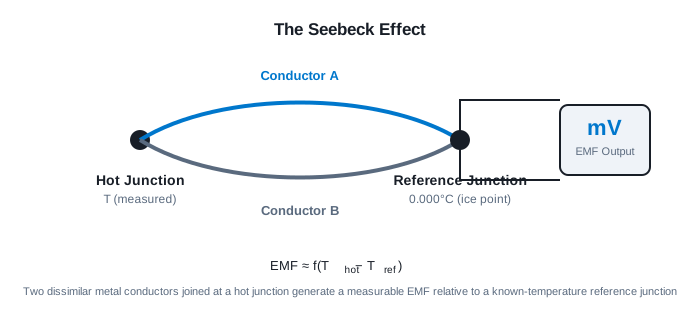
The Seebeck Effect — Where the Voltage Comes From
When two wires of different alloys are joined and the junction is held at a temperature different from the other (open) ends, a net voltage appears across the open ends. This is the Seebeck effect, discovered by Thomas Seebeck in 1821. The voltage is not generated at the junction itself but along the lengths of wire that sit within a temperature gradient; each conductor has a characteristic Seebeck coefficient, and the measured EMF is the difference between the two.
Because the output depends on the difference in temperature between the measuring end and the reference end, a thermocouple never measures an absolute temperature on its own. It measures a temperature relative to a known reference. Establishing that reference accurately is the central practical challenge of thermocouple thermometry.
The Three Junctions
Measuring (Hot) Junction
The welded or bonded end placed at the point of measurement. Its temperature is what you want to know.
Reference (Cold) Junction
Where the thermocouple wires connect to the measuring instrument. Historically held at 0 °C in an ice bath; today usually measured electronically.
Connection Junctions
Any additional junctions in extension wire or connectors. If they are isothermal and use matched alloys, they introduce no error.
Cold-Junction Compensation
Standardized EMF–temperature tables (ASTM E230, IEC 60584-1) are all referenced to a 0 °C reference junction. In the field the reference junction is rarely at 0 °C — it sits at whatever the terminal block temperature happens to be. Cold-junction compensation (CJC) corrects for this: the instrument measures the terminal temperature with a separate sensor, converts it to the equivalent EMF, and adds it to the thermocouple reading before converting the total back to temperature. The governing relation is:
E(Tmeasured) = Ereading + E(Treference)
A 1 °C error in the cold-junction measurement produces roughly a 1 °C error in the final result, so CJC accuracy directly limits overall accuracy. For the highest precision, an ice-point reference (0.000 °C) is still used — see calibration procedures.
From Millivolts to Temperature
Each thermocouple type has a defined, non-linear EMF–temperature relationship published as a polynomial reference function in NIST Monograph 175 and standardized in ASTM E230, E1751, and E696. An instrument reads the net EMF, applies cold-junction compensation, and uses the inverse polynomial for that type to return a temperature. Browse the full millivolt values on the EMF reference tables, or use the tolerance calculator to see the limits of error at any temperature.
The Standardized Types at a Glance
| Type | Conductors | Range (Standard) | Category |
|---|---|---|---|
| J | Iron / Constantan | 0 to +760°C | Base metal |
| K | Chromel / Alumel | −200 to +1260°C | Base metal |
| T | Copper / Constantan | −200 to +370°C | Base metal |
| E | Chromel / Constantan | −200 to +870°C | Base metal |
| N | Nicrosil / Nisil | 0 to +1260°C | Base metal |
| R | Pt-13%Rh / Pt | 0 to +1480°C | Noble metal |
| S | Pt-10%Rh / Pt | 0 to +1480°C | Noble metal |
| B | Pt-30%Rh / Pt-6%Rh | +600 to +1700°C | Noble metal |
| C | W-5%Re / W-26%Re | 0 to +2315°C | Refractory |
See the full side-by-side thermocouple types comparison for sensitivity, atmosphere compatibility, and color codes.
Advantages and Limitations
Advantages
- Very wide temperature range (−270 to +2315°C across types)
- Rugged, self-powered, no excitation needed
- Fast response, small size, low cost
- Point measurement at the junction
Limitations
- Lower accuracy than RTDs; non-linear output
- Requires cold-junction compensation
- Low-level signal susceptible to noise
- Drift and decalibration over time — see troubleshooting
Choosing between a thermocouple, an RTD, and a thermistor depends on range, accuracy, and cost — see Thermocouple vs RTD vs Thermistor.