The Complete
Thermocouple Guide
Authoritative technical reference covering all thermocouple types, ASTM & IEC calibration standards, EMF tables, tolerance classes, and industrial products. Built for engineers, calibration labs, and procurement professionals.
Select Your Thermocouple Type
Each type page contains full ASTM specifications, EMF tables, tolerance data, atmosphere compatibility, and application guidance.
Type J
−40 to +750°C
Iron / Constantan. Most common for general industrial use in reducing atmospheres.
Type K
−200 to +1260°C
Chromel / Alumel. Widest temperature range base-metal type. Most widely used worldwide.
Type T
−270 to +370°C
Copper / Constantan. Excellent for low-temperature and cryogenic applications.
Type E
−270 to +1000°C
Chromel / Constantan. Highest EMF output of all standard types. Non-magnetic.
Type N
−270 to +1300°C
Nicrosil / Nisil. Enhanced stability over Type K at high temperatures.
Type R
−50 to +1768°C
Pt-13%Rh / Pt. Noble metal. Used in high-temperature industrial and lab applications.
Type S
−50 to +1768°C
Pt-10%Rh / Pt. Noble metal. Primary standard for the gold point (1064°C) ITS-90.
Type B
+50 to +1820°C
Pt-30%Rh / Pt-6%Rh. Highest temperature noble metal type. Near-zero EMF below 50°C.
Type C — W5Re / W26Re
0 to +2315°C
Tungsten-5% Rhenium / Tungsten-26% Rhenium. Highest temperature capability of all standardized types. Used in vacuum furnaces, nuclear, and aerospace applications.
ASTM Referenced Throughout
Standard specification and temperature-electromotive force (EMF) tables for standardized thermocouples. Base metal types J, K, T, E, N.
Temperature-EMF tables for noble metal thermocouples. Covers Types R, S, and B platinum-rhodium series.
Tungsten-rhenium alloy thermocouples. Covers Type C (W5Re/W26Re) for extreme high-temperature service.
Standard method for calibration of thermocouples by comparison techniques. Defines reference junction and comparison procedures.
Guide for thermocouple verification. Establishes verification procedures to confirm thermocouple conformance to EMF-temperature tables.
International standard for thermocouple EMF tables and tolerances. Harmonized with ASTM for global compatibility.
Calibration Reference & Tolerance Data
Every thermocouple type has defined Standard and Special tolerance limits per ASTM E230 and IEC 60584-2. Understand limits of error, ice-point reference methods, comparison calibration techniques, and NIST traceability requirements.
Type K Standard Limits of Error
| Tolerance Class | Range | Limit |
|---|---|---|
| Standard | 0 to 1260°C | ±2.2°C or ±0.75% |
| Special | 0 to 1260°C | ±1.1°C or ±0.4% |
| Standard | −200 to 0°C | ±2.2°C or ±2.0% |
Per ASTM E230 / IEC 60584-2. Whichever is greater applies.
Thermocouple Tolerance Calculator
Calculate ASTM E230 limits of error for any thermocouple type. Select the type and tolerance class, enter a temperature, and get the applied tolerance instantly.
Limits of Error Calculator
ASTM E230 · ASTM E1751 · ASTM E696 · IEC 60584-2
—
Frequently Asked Questions
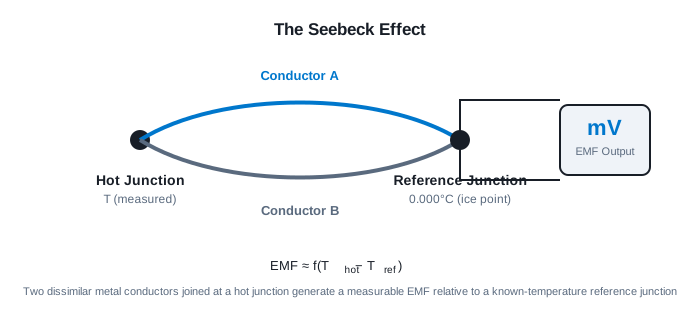
The Seebeck effect is the phenomenon whereby a voltage (EMF) is generated at the junction of two dissimilar metal conductors when that junction is at a different temperature than the reference (cold) junction. The magnitude of the EMF is a function of the temperature difference and the specific alloy combination. A thermocouple measurement system converts this EMF reading, referenced to a known cold junction temperature (typically 0°C), to a temperature value using standardized EMF-temperature tables per ASTM E230 or IEC 60584-1.
In a grounded thermocouple, the measuring junction is welded directly to the inside of the sheath wall, providing faster response time and better heat transfer. However, the junction is electrically connected to the sheath and therefore susceptible to ground loop noise. In an ungrounded thermocouple, the junction is isolated from the sheath by a layer of compacted mineral insulation (typically MgO), providing electrical isolation at the expense of slightly slower response. Ungrounded configurations are preferred in environments with electrical noise or where multiple thermocouples share a common instrument ground.
Type selection depends on temperature range, atmosphere, accuracy requirements, and cost. Type K is the most common general-purpose choice (−200 to +1260°C) for oxidizing atmospheres. Type J is preferred for reducing atmospheres up to 750°C. Type T is ideal for cryogenic and low-temperature applications. Types R, S, and B are required for temperatures above 1260°C in oxidizing conditions. Type C covers the highest temperatures (to 2315°C) but requires vacuum or inert atmosphere. Use the Types Overview page for a full comparison.
Ready to Request a Quote?
Add products to your quote cart and submit directly to our engineering team. We respond within one business day.