Type J Thermocouple
Iron / Constantan (Fe / Cu-Ni). General-purpose base-metal thermocouple optimized for reducing and vacuum atmospheres. Per ASTM E230 / IEC 60584-1.
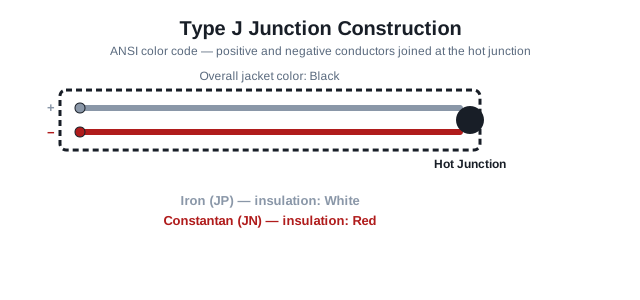
At-a-Glance Specifications — ASTM E230
Type J thermocouples are fully specified under ASTM E230. This standard defines the EMF-temperature reference functions, limits of error, materials specifications for JP (Iron) and JN (Constantan) conductors, color code requirements, and extension wire designations. IEC 60584-1 provides the internationally harmonized equivalent, with minor differences in tolerance classification nomenclature.
Conductor Alloy Specifications
JP — Positive Conductor
| Material | Iron (Fe) |
| Purity | Commercially pure iron, >99.5% Fe |
| ANSI Color | White |
| IEC Color | Black |
| Resistivity (~20°C) | ~10 µΩ·cm |
| Ferromagnetic | Yes — avoid in high magnetic field environments |
| Curie Point | ~770°C (decalibration risk above) |
JN — Negative Conductor
| Material | Constantan (Cu-Ni, ~55% Cu / 45% Ni) |
| Composition | Same alloy as EN and TN conductors |
| ANSI Color | Red |
| IEC Color | White |
| Resistivity (~20°C) | ~49 µΩ·cm |
| Non-magnetic | Yes |
| Note | JN is interchangeable with EN and TN in extension wire applications |
EMF Reference Table — Type J
EMF values in millivolts (mV) referenced to 0°C cold junction. Per ASTM E230 / IEC 60584-1. Values shown at 50°C intervals for reference — full NIST monograph tables available via the EMF Tables page.
| Temp (°C) | EMF (mV) | Temp (°C) | EMF (mV) | Temp (°C) | EMF (mV) |
|---|---|---|---|---|---|
| −200 | −7.890 | 200 | 10.779 | 600 | 33.102 |
| −150 | −6.500 | 250 | 13.553 | 650 | 35.872 |
| −100 | −4.633 | 300 | 16.325 | 700 | 39.132 |
| −50 | −2.431 | 350 | 19.090 | 750 | 42.922 |
| 0 | 0.000 | 400 | 21.848 | 800 | 45.494 |
| 50 | 2.585 | 450 | 24.607 | 900 | 51.877 |
| 100 | 5.269 | 500 | 27.393 | 1000 | 57.953 |
| 150 | 8.010 | 550 | 30.210 | 1200 | 69.553 |
Limits of Error — ASTM E230 / IEC 60584-2
The applicable limit is whichever value is greater (°C or percentage).
| Tolerance Class | Temperature Range | Limit of Error | IEC Class Equivalent |
|---|---|---|---|
| Standard | 0 to +750°C | ±2.2°C or ±0.75% (whichever is greater) | Class 2 |
| Special | 0 to +750°C | ±1.1°C or ±0.4% (whichever is greater) | Class 1 |
| Standard | −40 to 0°C | ±2.2°C or ±2.0% (whichever is greater) | Class 2 |
| Extension Wire — Standard | 0 to +200°C | ±2.2°C | — |
Atmosphere Compatibility
Type J is well suited for reducing, vacuum, and inert atmospheres. It is susceptible to rapid oxidation of the iron leg above 550°C and should not be used in sulfurous atmospheres.
Recommended Applications
Industrial Furnaces
Heat treatment furnaces operating in reducing or inert atmospheres where Type K would be susceptible to green rot. Suitable for annealing, normalizing, and carburizing processes up to 750°C continuous service.
Plastics Processing
Injection molding, extrusion, and blow molding equipment. The relatively high EMF output of Type J (compared to Type K at equivalent temperatures below 500°C) reduces noise susceptibility in electrically noisy environments.
Aging Ovens
Laboratory and industrial aging ovens with controlled atmospheres. Type J is a historical industry standard for many heat treatment specifications, particularly in legacy aerospace and automotive OEM processes.
Vacuum Systems
Vacuum brazing, sintering, and degassing furnaces. Iron does not oxidize in vacuum, making Type J reliable in applications where Type K would suffer from preferential aluminum oxidation at grain boundaries.
OEM Equipment
Legacy instrumentation and OEM systems specified to Type J. Wide installed base in food processing, packaging, and pharmaceutical equipment with standardized connection infrastructure.
Galvanizing Lines
Immersion measurement in zinc galvanizing baths (up to ~460°C). Type J resists zinc attack better than Type K in short-term immersion. Requires proper protective sheathing for continuous service.
Advantages & Limitations vs. Other Types
Advantages
- Higher EMF output than Type K below 500°C (better signal-to-noise)
- Preferred for reducing, vacuum, and inert atmospheres where Type K is unsuitable
- Lower cost than noble metal types R, S, B
- Wide industry installed base — legacy compatibility
- Resistant to zinc, lead, and tin contamination in molten metal applications
- IEC Class 1 (Special) tolerance achievable: ±1.1°C or ±0.4%
Limitations
- Iron leg corrodes rapidly in oxidizing atmospheres above 550°C
- Curie point at ~770°C causes magnetic permeability change — risk of calibration drift
- Not recommended for use above 750°C continuous service temperature
- Susceptible to corrosion in humid or moist environments
- Cannot be used in sulfurous atmospheres (iron sulfide formation)
- Narrower temperature range than Type K or Type N
Color Code Reference
| Standard | Positive (+) Conductor | Negative (−) Conductor | Overall / Jacket | Connector Body |
|---|---|---|---|---|
| ANSI (US) | White | Red | Black | Black |
| IEC 60584 (Europe) | Black | White | Black | Black |
| BS 1843 (UK, legacy) | Yellow | Blue | Black | Black |
| DIN 43714 (Germany, legacy) | Red | Blue | Blue | — |
Extension & Compensating Wire
Type JX Extension Wire — ASTM E230
Type J thermocouples use JX extension wire — Iron (positive) / Constantan (negative) — which is identical in alloy composition to the thermocouple conductors themselves. This provides true thermocouple extension with minimal error contribution when properly matched.
| Parameter | Specification |
|---|---|
| Extension Wire Designation | JX |
| Positive conductor alloy | Iron (same as JP) |
| Negative conductor alloy | Constantan (same as JN) |
| Max extension wire temp | 200°C |
| Standard error (0–200°C) | ±2.2°C |
| ANSI color (+/−/jacket) | White / Red / Black |
| Note | JX wire cannot be substituted with KX extension wire — alloys are different and will introduce errors |
Installation & Application Guidance
Junction Configuration
For fastest response in applications where electrical isolation is not required, use a grounded junction. For applications with electrical noise or shared instrument grounds, use an ungrounded (isolated) junction. Exposed (bare wire) junctions provide the fastest response but are only suitable for non-corrosive, non-conductive environments.
Insertion Depth
Minimum insertion depth of 10× the sheath diameter is recommended to minimize conduction error. For 1/8" (3.175 mm) OD sheath, a minimum insertion depth of ~32 mm (1.25") is required. Deeper insertion further reduces stem conduction error.
Reference Junction
All thermocouple EMF-temperature values in ASTM E230 are referenced to a 0°C (ice point) reference junction. Modern instrumentation applies electronic cold junction compensation (CJC). For precision calibration, an NIST-traceable ice bath or fixed-point furnace reference is required per ASTM E220.
Drift & Aging
Type J thermocouples are susceptible to calibration drift at elevated temperatures due to iron oxidation. In critical applications, periodic in-situ verification per ASTM E2846 is recommended. Replace thermocouples showing drift exceeding the applicable tolerance class limit.
Type J Products
TCG-GND-J-18
Type J Grounded Probe
TCG-UNG-J-18
Type J Ungrounded Probe
TCG-WIRE-J-24